
Yes, adults over 40 can receive Invisalign treatment. Age alone does not rule out orthodontic treatment. The planned tooth movements, the health of the tissues supporting your teeth and any existing dental restorations matter more. An examination establishes whether clear aligners or another approach is appropriate.
- Orthodontic treatment can be possible in your forties, fifties and beyond. Suitability depends on your individual findings, not a fixed age limit.
- Active periodontitis and other conditions requiring treatment need assessment and management before teeth are moved.
- Crowns, bridges and implants affect planning in different ways and must be considered before treatment.
- Wearing time, check-ups and retention after active treatment need to fit your everyday life.
Why this matters
Many adults over 40 assume that teeth can only be straightened when you are young. That is not the case: adult teeth can also be moved orthodontically. The first step is to establish which movements are appropriate and which method can achieve them.
By your forties, your dental history may include fillings, crowns, previous orthodontic treatment or missing teeth. Perhaps teeth have shifted again over the years. These concerns are useful starting points for a consultation, but do not establish a diagnosis on their own.
Can adults over 40 get Invisalign treatment?
Yes, when the individual conditions are suitable. Aligners apply controlled forces to move natural teeth gradually. Fixed braces also produce planned tooth movements. The choice depends on tooth position, bite, supporting tissues and the treatment goal. Significant jaw discrepancies may require more than aligners alone.
Compare the same practical questions when considering the options:
| Criterion | Invisalign aligners | Fixed braces |
|---|---|---|
| Visibility | clear; bonded attachments may be visible | depends on the system; tooth-coloured or lingual options may be available |
| Removable | removed for meals and cleaning | remain attached to the teeth |
| Complex tooth movements | individual assessment; additional appliances or other methods may be needed | may be preferable for certain movements; also depends on the findings |
| Cleaning | clean teeth, interdental spaces and aligners | clean teeth, interdental spaces and around brackets and wires |
| Patient participation | wear as prescribed and attend check-ups | careful hygiene, check-ups and any prescribed elastic wear |
Aligners can be a good option when they can achieve the planned movements and you can maintain the daily routine. Fixed braces may be more appropriate when particular movements or the starting conditions favour them. Visibility should not be the only deciding factor.
Invisalign and periodontitis: what needs checking first?
Active periodontitis must be controlled before orthodontic treatment. This concerns not only bleeding gums but also the tissues and bone supporting the teeth. After appropriate preliminary treatment, the team reassesses which movements are acceptable.
Stable gums do not automatically mean aligners are suitable. Advanced periodontitis may require close collaboration between periodontal and orthodontic care; fixed appliances may be preferred depending on the findings. Monitoring and individually planned supportive care remain important. Professional cleaning alone does not replace periodontitis treatment. EFP: orthodontics in advanced periodontitis
Invisalign with crowns, bridges or implants
A crown on a natural tooth is different from an implant-supported crown. A crowned natural tooth may be moved when conditions are suitable. An integrated implant does not move during ordinary orthodontic treatment. A bridge connects several teeth and can restrict their individual movement.
When restorations are already present or planned, consider tooth alignment and restorative treatment together. Bring existing records and ask: which teeth will move, which restorations stay in place and what sequence makes sense? Read more about planning implant treatment.
Invisalign and bruxism: mention grinding or clenching
Tell the treatment team if you grind or clench your teeth, have jaw discomfort or already wear a bite guard. This information belongs in the treatment plan and the monitoring of your appliances.
Do not independently wear an existing grinding guard over an aligner or instead of your prescribed aligner. Ask how grinding or clenching will be managed during treatment. Grinding alone does not establish a specific delay or mean that adding a night guard is the right solution.
Why suitability differs between adults over 40
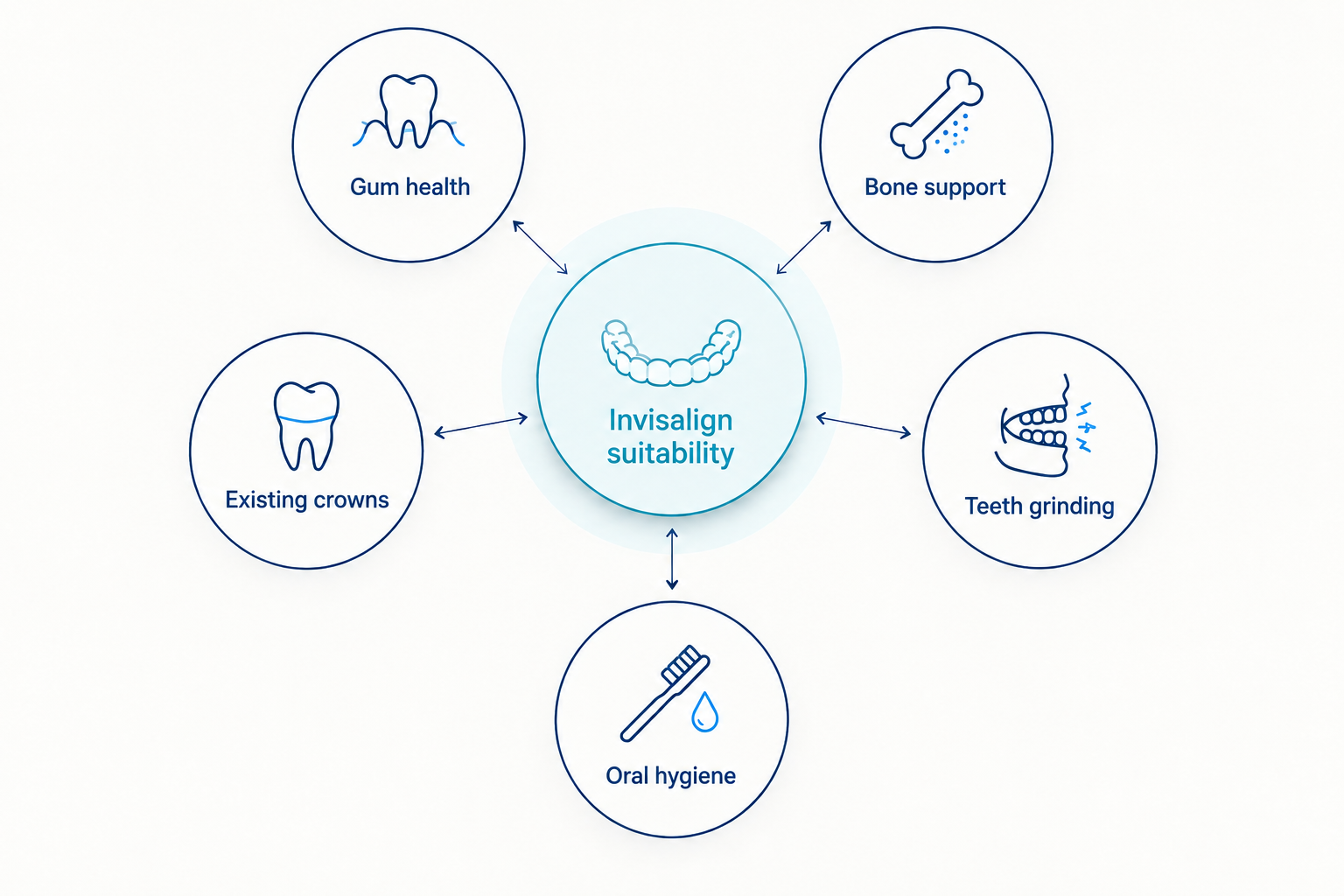
Every starting point is different. These questions help make the consultation specific:
- Gum health: Is inflammation present that needs treatment before tooth movement?
- Bone support: How well are the teeth supported? Periodontal bone loss is not the same as a general bone-density measurement.
- Existing restorations: Which natural teeth can move, and which bridges or implants constrain the plan?
- Bruxism: Do symptoms, wear or an existing bite guard need consideration?
- Oral hygiene: Can you clean consistently, including on the go and in difficult-to-reach areas?
- Wear routine: How will meals, cleaning and prescribed wearing time fit into your day?
How long does Invisalign treatment take after 40?
The manufacturer gives an average of 12 to 18 months. This is not a timeframe established specifically for people over 40 or a promise for an individual case. A limited treatment goal may take less time; complex movements, preliminary treatment or additional aligners may lengthen the process. Ask for a personal schedule including check-ups and subsequent retention. Manufacturer information on duration and wearing time
Is Invisalign possible with missing teeth?
Yes, orthodontic treatment can form part of a combined plan for gaps and dental restorations. Depending on the findings, spaces may be closed or prepared for a replacement tooth. The position of any planned implant must fit that plan. Discuss the sequence before individual treatment steps begin.
Can Invisalign be combined with professional cleaning?
Yes. The type and frequency of professional cleaning depend on individual needs. Daily care remains important: clean your teeth and interdental spaces and care for the aligners as instructed. Periodontitis also requires targeted supportive care; a cleaning appointment alone is not a substitute.
Discuss your Invisalign suitability in person
Considering a change to your tooth alignment? Request a consultation at MeinZahnarzt in Lörrach-Stetten. Bring existing records and the questions you would like to discuss.
Frequently asked questions
Am I too old for Invisalign after 40?
Not because of age alone. Your findings and treatment goals matter. An examination establishes which approach is suitable.
Is Invisalign possible after periodontitis?
Orthodontic treatment may be possible under suitable conditions once inflammation is stably controlled. Whether aligners or another method are appropriate is a separate decision.
How long does adult Invisalign treatment take?
Duration is individual. The manufacturer's average of 12 to 18 months is a reference, not a personal prediction. Preliminary treatment and retention need separate consideration.
Is Invisalign better than fixed braces?
Not universally. The approaches have different requirements. The planned movements, clinical conditions and everyday practicality determine the choice.
Can Invisalign be combined with implants?
Combined planning may be possible. Existing implants remain in their position; they do not move like natural teeth.
What should I do with my grinding guard?
Bring it to your consultation. The team will plan how to manage grinding or clenching during orthodontic treatment. Do not combine or swap appliances independently.
How often are aligners changed?
Commonly after one or two weeks. Follow your individual treatment plan rather than choosing your own change schedule.
One more thing: what happens after the last aligner?
Teeth can shift again after successful orthodontic treatment. Retention therefore belongs in the discussion from the beginning. Before starting, ask about care after active treatment, planned check-ups and the services included in the cost estimate. This helps you consider the whole process, not only the first aligner.